Showing posts with label perspective. Show all posts

Monday, June 20, 2016

Perspective - PVR Cinemas : How they revolutionised film viewing experience of India || Sushman Das || IIM Lucknow || March 2016 edition

PVR Cinemas : How they revolutionised film viewing experience of India?

- Sushman Das
IIM Lucknow

PVR is one of the most fascinating success stories of Indian liberalization and has redefined the film-viewing experience in India. From introducing the first multiplex experience in India to introducing newer properties like PVR bluO, it has gone from strength to strength. With a market capitalization of over ₹ 2000 crore, the PVR Group is the largest player in the Indian cinema exhibition space.
The idea took seed when Ajay Bijli, its founder, on a visit to Orlando, Florida had his first experience of world-class cinemas and was fascinated by the new-age facilities of multiplexes. Priya cinema,which had been bought by Ajay Bijli’s father and was frequented by Ajay became the first in India with a Dolby sound system.

The technical transformation at Priya cinema and screening of all big-budget Hindi films and Hollywood blockbusters made it acquire a cult status among then cine-goers. By entering into a 60:40 joint venture with Village Roadshow Ltd of Australia, Ajay tried to leverage the technical expertise the Australian firm had in setting up multiplexes. PVR Anupam was one of the first cinemas which were jointly renovated. Transformed into the first multiscreen cinema in 1997,it became a runaway success.

Though myriad reasons can be attributed to PVR’s success, one of the key factors is that the group has looked at the business through the customer’s prism: what does the customer need and what is the market offering it? This took precedence over the typical emphasis on returns on investment or net profit margins. This shift in focus, backed by market studies, research and interactions with market players led to PVR successfully building a world-class brand. Location was understood to be one of the important building blocks of a successful film entertainment and retail business and when it came to establishing multiplexes, PVR chose locations extremely carefully. Target market segment, socio-economic strata and catchment area are till date examined in granular detail while expanding to newer cities. The company acknowledges that quality of experience is a critical building block and takes minute care right from construction to fittings and styling— everything is fashioned to provide a plush viewing experience. Rich ambient lighting, ideal temperature controls ensure total comfort and plush common areas characterize the chic and premium PVR experience.

PVR attracted film distributors by bringing in transparency into the ticketing system by introducing computerized bookings. All this has had tangible results and the brand has been able to garner higher seat occupancy levels in cinemas irrespective of average ticket prices.

Growth is imperative for any business. PVR, too, has systematically scaled up film-exhibition
activities through an organic process for nearly seventeen years— be it in product, positioning, promotions or pricing. After the 9/ 11 attacks, Village Roadshow Ltd exited the joint venture and ICICI Venture picked up its 40 per cent stake for $ 10 million. In 2007 the company forayed into production with with Taare Zameen Par, made in collaboration with Aamir Khan Productions. The firm has established key relationships with many Hollywood studios including Miramax, New Line, IEG and Zee MGM. In November 2012, PVR acquired the entire 69 per cent stake of promoters in Cinemax India Ltd. This acquisition was one of the fastest-paced takeover deals in India’s corporate history. The objective was to create India’s largest movie exhibition chain and also to
effectively utilize the synergy potential and cost benefits that would accrue from the larger scale of operations of the combined network, thereby creating value for all stakeholders.

In 2013, PVR multiplied in size and operations. The company expanded its presence from 27 cities to 41 and its market capitalization was reported to be ₹ 2,204 crore (as on 1 February 2014).The company today owns almost a third of India’s 1,500 odd multiplex screens. The Cinemax acquisition gave the company a launching pad in the south in which it was absent till then. The company plans to add 70 to 80 screens every year and have 1,000 screens across India by 2018 through organic and inorganic growth. In 2016, PVR currently operates a cinema circuit comprising 474 screens spread over 106 properties in 43 cities across India and is the largest cinema exhibition company in India. PVR is today amongst the top ten cinema companies in the world with respect to admissions per screen and has entered the World Economic Forum’s list of fastest-growing ‘Global Growth Companies’.
Despite the advent of online consumption of film entertainment, PVR has maintained its relevance by redefining the cinema-viewing experience for movie connoisseurs by providing world-class immersive viewing. PVR has capitalized on the totality of experience which today’s young generation seeks. By turning theatres into classy, stylish luxury spaces and quasi-community centres, a PVR cinema assures ‘absolute escapism’, in the words of Ajay Bijli. By developing and positioning sub-brands like Gold Class cinema, Director’s Cut luxury cinema, IMAX technology theatres and Enhanced Cinema Experience (ECX) to cater to specific customer segments, it has set new benchmarks in the cinema exhibition business.

PVR Pictures, the company’s flagship motion-pictures arm is involved in the distribution of major Hollywood movies in India. In 2013-14, it was involved in the distribution of all the major 2013– 14 Oscar-nominated films— The Wolf of Wall Street, American Hustle, 12 Years a Slave, Her, Lone Survivor, Nebraska, Dallas Buyers Club. PVR became the 1st major multiplex chain to introduce the concept of alternate content to India by launching a brand new platform— PVR LIVE— which showcases live and recorded events. The company supports independent filmmakers by releasing their films under the PVR Director’s Rare banner and has been a vanguard in bringing about a paradigm shift from star-driven cinema to content-driven in India. Documentary films like Superman of Malegaon and Fire in the Blood have attracted audiences under this banner.

The company’s newest venture is bluO, a one-stop entertainment destination which promotes bowling. A 51: 49 joint venture between PVR and Major Cineplex Group of Thailand, bluO aims to do for bowling what T20 has done for cricket. The format is a mix of fun and bowling— world cuisine, music, sport— coming together. bluO is a unique concept and elements like an exceptional rhythmic interior design with a sensual play of light and form and a ceiling that emanates as a ripple wave makes the place energetic, stylish and in sync with the lifestyle and ideology of today’s youth. As of 2015, PVR bluO had six centers, across Delhi NCR, Bangalore, Pune and Chandigarh. By offering services like PlayStation lounges, private karaoke lounges, exclusive platinum lounges, stylish merchandise, a tattoo studio and well-equipped bars; it aims to rival pubs and nightclubs as spaces to hang out in.

The company has also shaped the growth of cine advertising in the country. By expanding the scope
of cinema watching to a rounded entertainment-cum-leisure activity where the audience voluntarily surrenders to the environment, which yield higher receptivity to brand messaging as compared to other mediums ,its cinema advertising revenue rose to ₹ 141 crore in 2015 which is equal to the combined sales of all competing players.

All this has resulted in PVR being listed as India’s most trusted and attractive brand by The Brand Trust Report 2015 in the category of entertainment and cinema display. Ajay Bijli was awarded the Most Admired Multiplex Professional of the Year in CMO Asia’s Multiplex Excellence Awards.
With the advent of ‘smart cities’ and rising disposable incomes in urban India,PVR promises to be to be force to reckon with in the Indian entertainment space in the years to come.

Perspective - Customer Service Brilliance : Forgotten Marketing Heroics || Wasim Akhtar || Chandragupt Institute of Management, Patna || February 2016

Customer Service Brilliance

- Wasim Akhtar
CIMP

The focus of my article is to look at the customer service from the perspective of start ups.
For all those who are looking for start ups or advising start ups, the article may come in handy. And how the customer service can not only give you a competitive advantage but will also edge out the competition in the early going itself. There is an ample of amount of studies that says fifty percent of the businesses fail. A large of that is because they haven’t given a thought about differentiating themselves and they haven’t included customer service in that equation. Let’s just talk about customer service and why should people really pay attention and have a enterprise system for managing customer service today.

A typical company with 24/7 box and the moment you clicked and you have someone who will answer the phone is not smart. What smarter companies doing these days are quite different things at customer service front. They are actually valuing service level agreement. They are producing pretty much the same products like any other but it’s the service they provide around the product and way they engage with it is actually what helps them differentiate. So, we think about small companies and let’s take an example like ZENPAYROLL and it is an awesome company that is disrupting the industry. They are using their support to differentiate. They are allowing themselves to engage with the customers in a deeper way. They take it to a level deeper and leveraging it with product innovation as well. They have their product managers engaged in desk and looking at the tickets to get that information straight from the source. So, when somebody is complaining about something or they frustrated, there might actually be a product idea or product feature painted into that. Having that direct line to see that the customers actually took the time to write or say gives product managers a little bit of edge when they are innovating and that’s what people need.

So let’s shift our focus on what is the best practice when customers are so empowered
because of social media. Let’s give a thought when such customer gets pissed off or something goes wrong, what best practices has to be diffused because it is not personal experiences any more it can get public and it may affect your brand at large. Research has shown that 89 percent of the customer won’t do business with you again if they had a bad initial support experience and yes, they would be vocal about it. SO it is like you call up customer service desk and it doesn’t work and you’re like, ‘I am not going to buy’ and that is substantial business when the figures grow at some pace. Because there are other alternatives available and lot of other products that people are approaching to in different ways. Issues come up in every companies and there is very little one can do about it. So if we talk about how can companies deal with it, the best way for a support team to address and address it head on and if you have a tool or desk to deal with it. It becomes
an east going process. You can reply to it and reply it at multiple places and owning the experiences from the good to the bad. Companies have tried to shy away from anything bad but that doesn’t really work either. They got to accept the fact that it is not going to go that great and when it doesn’t own it, fix it and be proactive and rapid response is critical. I will share my experience with OLACABS. I was in ola cab in Bangalore last month and I got mischarged and it was accidental. So they drop me an email stating that it double charged you and the next ride you get is free. Now that is the kind of customer service that keeps the people engaged. Like, think about the companies like ZAPPOS, when they started many people thought this is a crazy idea. Who is going to buy shoes online? Now every time a season people go online to buy shoes from Zappos. The customer service is so easy there. And what is surprising to me is that they are not giving deals on shoes. They are not competing on prices rather they are competing on service. Lot of reviews says that they don’t really bother paying extra to the company they’re constantly engaged and they keep advocating about it as well. Why would a customer care about saving 100 bugs when he has got great relationship with the company going? BOOM! Honesty is the best policy when it comes to support. People don’t like jerked around.


When it comes to the idea of best practices of things, you need to think about the support road map. Support road map is equally important as product road map. And companies that do not do that won’t do well. Look at some of the best customer support oriented companies, they have big customer desk and start ups are handling things like 24 hours. Start ups in the west have used the best practices and able to bring the support within an hour and they did it by thinking about how can they optimize the engagement experience. They had a plan for the support. It is very imperative to optimize the support. Consider start ups like OYO ROOMS and STAYZILLA. It is critical for them specially. Suppose you booking the room after 12o’clock. So let’s say you booked it at 1.30 PM and you thinking of getting a room at 4o’clock. There is a very little time. If something goes wrong the customer would have no clue and retaliation would be instant. They are businesses based on making sure that actually happens. Many people have talked about it is “the handling time”. How long is it taking to pick up a case?  In their situation they are supposed to do it at a lightning fast speed but in some bad practices people touches a poor case just to touch it and meet the service level agreement. And that’s wrong. Putting all the emphasis on the support team to get a certain number of hours done without telling them how to do it a constructive way. It is more about their engagement. It is more about willing to pay more for shoes at ZAPPOS because you like them. There is a “like factor” that a consumer takes into account.

Well we all make mistakes and in service industries like most start ups are it is inevitable to
avoid mistakes. How do you deal with it and having plan about it? It really is. Having a roadmap, a plan and an eye where you want to take in the future. A plan for today is one thing but don’t plan a product roadmap and say, “Hey, this is what I am going to build this month”? You do but you have 6-12 months plan and they may change but I think that the companies that don’t think about what’s my support system look like now and what’s it going to look like in 10 years when it is big, I think that is where the focus on managerial outlook of an organization be like.

People are looking at support as a different vehicle than to see if you computer is on or off. It is a loyalty program in a way and a brand building process. At the end of the day the fact of the matter is there is a lot of competition out there. People can knock off your product very easily. It is very easy to copy stuffs but you cannot copy the love and the concern that a company has for actually customers and that is an intangible advantage a start up should focus upon.

It is very imperative for start ups to think about creating and delivering values not only in terms of products but also in terms of support that will help them to build loyalty, affection and brand over a period of time.

Perspective - Sustainable Marketing || Saurabh Pandey || XLRI Jamshedpur || February 2016 edition

Sustainable Marketing 

-Saurabh Pandey
XLRI, Jamshedpur


What is Sustainable Marketing?


We are very well aware of the term sustainability. We also know what the definition of
marketing is. But what exactly is Sustainable Marketing? What exactly does this term signify?
The truth is, Sustainable Marketing has not been precisely defined. However, both academicians
and practitioners have provided us with various interpretations. Thus it becomes imperative to first of all define what Sustainable Marketing is as we understand it before we move any further. Sustainable Marketing can be defined as an all-inclusive approach that not only satisfies the needs and demands of customers, as done in traditional marketing, but also puts an equal emphasis on environmental and social issues, thus generating profit in a sustainable way. Recently, there has been a profound increase in the value that consumers place on eco-friendly products and hence there is a rise in the commitment of the companies to deliver environment friendly products and services.
Sustainable Marketing seeks to capitalize on this increased customer preferences and company’s commitment towards eco-friendly products. This cannot be done through age old marketing mix and strategies alone. There is a need for new strategies and concepts which align with the goal of sustainability.


This article will majorly focus on following three areas:-
a) How to revise strategies of marketing to incorporate an ecologically balanced approach
b) Modification of 4Ps for alignment of the organisation with the objectives of sustainability
c) Benefits that an organisation will receive by adopting a sustainable approach


Sustainable Marketing Strategy

Traditionally marketing has been driven by economic objectives like profit and market share. The situation may not be the same in near future. Companies will have to change their behaviour, forced by climate change or shortage of raw materials. This change of behaviour can also be triggered
due to shift of consumer preferences to the environment friendly products or due to adoption of sustainable practices by a competitor. In any case sustainable marketing will have to be a part of strategies of the companies in order to succeed in the market. 
One of the most important decision would be to decide whom to target and how. Segmentation of the customers and positioning of the product needs to be remodelled from the angle of sustainability in
order to adapt to the changing circumstances.

Segmentation
Currently segmentation is done on the basis of demographics, psychographic or behavioural characteristics of the customers. These parameters will however not truly reflect an individual’s environmental attitude or his consumption habit of ecological products. Sustainable marketing requires a thorough understanding of consumer’s current behaviour and his willingness to act sustainably. This will help a marketer understand the level of involvement a consumer has when it comes to ecological products, their reasons for using an environment friendly product or their reasons for opposing it. Insights provided by this understanding will help marketers choose their target group effectively and meet their demands in a suitable way. Numerous attempts have been made to segment customers on the basis of their environment friendly practises.
Segmentation done by British government’s department for Environmental, Food and Rural affairs is a good example. They divided the population into seven segments on the basis of their engagement in sustainable practices. These seven segments are as follows: 

  • Positive greens
  • Waste Watchers 
  • Concerned Consumers
  • Sideline Supporters
  • Cautious Participants
  • Stalled Starters
  • Honestly Disengaged (Reeves, 2007). 
First three comprise of customers who care about the environment and have adopted sustainability
wholeheartedly. Next three are those in which sustainable behaviour is low to non-existent and last one have no interest in environment whatsoever.
This sort of segmentation gives a clear picture as to which segment needs to be targeted and how a product needs to be positioned in the mind of the consumers.

Positioning
Positioning is defined as how the product is perceived by the customers and what position does it take compared to the competitor’s product. With increase in the use of sustainable practices right from the production process to distribution, it is important for the company to convey this message to the end users. The final consumers should be well aware of the initiatives taken by the company in order to be more environment friendly. This requires modification of the way the positioning of the
product is being done.
A very good example of this would be Coca-Cola which proudly declares itself as ‘water neutral’. This positioning helps Coca-Cola gain a positive attitude from consumers who perceive Coca-Cola as an environment friendly company.


Sustainable Marketing Mix

We are aware of the 4Ps of marketing: Product, Price, Place and Promotion. However, effective utilization of 4Ps in order to achieve the objective of sustainability is not well known. Most of the sustainable initiative taken by the company are focused on the operational issues and any marketing effort undertaken is focused on a single ‘P’ Promotion. 
However, 4Ps present an opportunity to the organisation, if wisely used, to work effectively to
achieve the sustainability agenda. Let’s look at each ‘P’ of the marketing mix and understand how we can effectively use them.

Product
Product is a tangible good (soap, automobile etc.) or an intangible service (hotel, airline etc.) which is marketed to consumers to meet their specific demand. It can also be defined as anything that can be offered to satisfy a need or want.
When talking from the perspective of product there are various stages where the concept of sustainability can be applied. Starting point is procurement of raw materials in an environment friendly manner. Going further, use of renewable energy resources in the production process
and increasing the energy efficiency of the entire production process. Generation and disposal of waste is another area which can be improved upon by using sustainable practices. Conducting a Life Cycle Assessment of the product and following a cradle to cradle approach can help the company reduce its carbon footprint. 
For example, most mobile companies now take the responsibility for disposal/ recycle of e-waste and battery, following cradle to cradle approach. However all of this comes at a price, which forms a major factor in the consumer purchase decision.

Price
Sustainable products have always been perceived to be more costly than their conventional counterparts. This has severely impeded their growth and acceptance on a large


scale. However, this is not a true representation. Environmental cost, social cost, cost of biodiversity loss are seldom included in the production cost of any product. Instead they are treated as externalities, which are costs that are shifted to the society and hence providing customers with a skewed picture of the actual cost they bear for any product.
Marketers need to reduce this pricing barrier either by increasing the perceived value of the product or through reducing the price gap through innovation. Products such as organic food brands, Starbucks, LED bulbs have done a commendable job of increasing the perceived value in the
mind of customers and charging a premium for their products.
Another approach could to be target people who are financially better off or people who are environmentally conscious. This would help companies to get a market for products which have a premium pricing due to their environment friendly nature.

Place
Place can be a physical store or a virtual store where products are sold and it also includes how the product is distributed. The issue of sustainability can be looked from various perspectives here. Right from building of energy efficient stores, green buildings that handle waste disposal efficiently to effective usage of fuel in transportation and using green vehicles for distribution purpose can all be effective measures to reduce the carbon footprint. With the increasing focus on sustainability some of the brick and mortar stores are moving toward more environment friendly practices. Stores like Walmart are building more energy efficient stores, using environment friendly fuel in the trucks and green packaging material. There are examples of retail stores using solar panels for their daily energy needs. Some of the retail stores have even adopted a policy of buying goods only from companies which adopt environment friendly practices.
These practices not only increase customer base of the retailers by appealing to environment friendly consumers but it also helps them earn a premium by generating value for which customers are willing to pay. Moreover it reduces cost for retailers in the long run and hence increases profitability.

Promotion
The biggest task of the marketers is to convey the environment friendly practices adopted by the organisation to the end consumers. Consumers must be made aware of the sustainable practices undertaken by the organisation. The objectives of promotion can be listed out as follows:-
Raising awareness regarding the use of sustainable products

  • Conveying the sustainable practices implemented by the company and use it as a differentiating factor
  • Informing consumers regarding the sustainable use of the product or how can consumers be eco-friendly by using the product
  • Persuading consumer to use the product
  • Awarding consumers for using an eco-friendly product

To achieve these objectives a mix of direct promotion, social and print marketing, personal selling
and advertisements are to be used. These methods of marketing can be used in different ways to promote a particular product. What is more important though is to convey the value a product will deliver if bought by the customer. True, customers do care about environment and sustainability, but
the value they receive from the product remains most important. It is the task of marketers to make customers realize the value of the product without any harm to the environment.
This can be done by conveying benefit through efficiency, cost saving, environment protection, safety, health benefits, symbolism, status and convenience. For example home appliances like LED/CFL bulbs or CFC free refrigerators promise cost saving along with environment protection. Hybrid cars promise fuel efficiency whereas organic food promises health and safety along with their eco friendly nature.
The potential of effectively using marketing strategies for sustainability is huge. However, one major question that remains for all the companies is ‘What’s in it for me?’ The following section tries to answer this particular question.


Benefits of Sustainable Marketing

Most of the aforementioned text focuses on the benefits received by the end consumer due to the sustainable practices followed by the companies. Let us now list down the benefits an organization derives from eco-friendly practices.
  • Competitive advantage: Organization adopting sustainable practices early will have the first mover’s advantage. Early adoption of eco-friendly practices will not only help company move towards a greener ecosystem but will also help gain a leadership position in the market. It will help the organisation gain the market share and reputation as a green company.
  • Cost Saving: Profit is the main objective of any commercial organization. Companies continuously strive to increase their profit by reducing costs associated with production, distribution, promotion etc. Adoption of sustainable practises helps company to save costs in the long run. ITC’s classmate is a good example. By refusing to import pulp and developing in-house technology to develop sustainable ecosystem helped ITC to reduce production cost and gain leadership position in the market.
  • Reduced Risk: With changing climate conditions there is a big question mark on availability of raw materials and fulfilments of energy requirements in the future. Mitigation of these risks can only be done by moving to cleaner forms of energy and adopting sustainable practices in order to increase efficiency. Moreover, due to impending changes in the environment, government across countries will impose strict environmental measures in order to control the changes. Waiting for these restrictions to be applied and then conforming to them makes no sense. Proactive approach helps companies to avoid problems of compliances in the future.
  • Increased market share: Involvement of eco-friendly practices help the companies to appeal to environment conscious people. It will help the company increase its customer base. Also gain in reputation due to use of sustainable practices will attract more customers. All of this will results in increased revenue and hence increased profits.

Conclusion

Sustainable marketing is undoubtedly an important concept which when integrated with the daily operations of a firm has the potential to yield huge benefits. Effective implementation of sustainable practices coupled with effective use of sustainable marketing strategy and marketing mix can prove to be a boon for a company in today’s scenario of global warming and climate change.

Saturday, February 6, 2016

Perspective - The New Era of High Tech Terrorism: a marketing perspective || Sidhartha Bhattacharyya || IIM Udaipur || January 2016 edition

The New Era of High Tech Terrorism: 

a marketing perspective

Sidhartha Bhattacharyya
IIM Udaipur

The author George Carlin once quoted “Never underestimate the power of stupid people in large groups.”  Well this quote is not true in its entirety and as I shall hopefully convince you through article. To get to the point, a man who has been living in a civilized society and is not averse to reading a newspaper would have heard of the dark cloud looming over the world by the name of The Islamic State of Iraq and Syria. They are a well know terrorist organization who operate out of the mentioned 2 countries and have amassed a huge army as well as land due to hostile takeovers. In the midst of gathering one of the largest and most devout armies of the world they have planned and masterminded some of the cruelest and horrific acts of terror the people of the world have had the misfortune of seeing.

The Successor Has Taken the Throne
At this point one would logically raise the question, about where has this terrorist organization been able to muster such a large work force. One must think that the ISIS consists of the people from Al-Qaeda who have shifted their allegiance to a stronger organization. The strength of the organization is said to be around 200,000 (1) which is significantly greater than its predecessor having just over 28000 members at it strongest (2). So one may ask where the new Islamist Extremists are coming from who never joined the Al-Qaeda.  Al-Qaeda has willingly taken a backseat in this affair as they cannot compete with the sheer size and scale of operations at ISIS and have been terms as too extreme by the current head of Al-Qaeda, Ayman al-Zawahiri.  The scale has taken things to such an extent that “Coca-Cola” and “Pepsi” can be substituted by “ISIS” and “Al-Qaeda”. All this has happened due to the fearful beauty of the marketing and advertising strategy of the ISIS.

Frightfully Beautiful Strategy
Considering the fact that ISIS is a terrorist organization which incorporates sort of medieval practices people think that it is sort of an archaic organization. But on the contrary the organization or “Caliphate” as they term it is led by a group of highly intelligent and tech savvy group. Like any major company, ISIS has a well set out business plan which they intend to execute. Their plan is to impose the Sharia law on the whole world. Like every James Bond their intention is world domination. To do this they must have certain strategies and a marketing plan. Well that requires a simple STP analysis. The segments they have at their disposal is the whole Muslim population of the world which was 1.6 billion people in the year 2010 (3) and is also the fastest growing religious population of the world. Thus they have an ample group of people to target. So they set up their strategy to target the young Muslim population from around the world aged between 20 and 30. The reason they have been targeted as they are the young rebellious individuals of the world and have been aliened by the society around them. The impact of racial attacks and constant hate received by the Muslim community enraged these post-adolescent young adult and send them into a frenzied state of rebellion. Now the beauty in the ISIS strategy is their positioning. They positioned their organization in a way that it gives a safe haven to these so called outcasts of society and where they are free to practice their religion and all the extremist facets attached to it. They provide help to those who are in the need of this sense of belonging. People from all around the globe and majorly countries like the UK and Australia are falling prey to these promises.

Propaganda Propagation
ISIS may follow extremist laws but their methods of communication are highly varied and try to find different kinds of media through which they can target their audience. Videos are their prime source of media attention for the organization where their extremist acts are caught on tape and published in social media for the entire world to see. On the 4th of July they released a movie by the name of “Healing the Chests of the Believing People” where they show the execution of 25 seemingly teenage soldiers after they have been caught by the ISIS.  They feel that this video along with videos like “Punish Them Severely to Disperse Those Who Are Behind Them”, “A Message Signed with Blood To the Nation of the Cross”, and “Healing the Souls with the Slaughtering of the Spy” will “inspire social change” in the western world. They intend to portray the concept of Jihad to the rest of the world and attract thousands of young impressionable souls into their bloody path like so many already have. These videos include the beheading of several foreign journalists which do attract western military attention. Now this is not something that the organization would necessarily want but once people see their “brothers” getting killed at the hands of people who have been suppressing and isolating them from their childhood.

Gender Based Strategy
These strategies work on men very well but for women they have to use a separate method to help them join. Just like the men they have been isolated in these civilized societies and have a sense of hate welling up inside them. Along with this Muslim women do not have much say in the choices they make. Most of what they do is chosen by the family and are forced to follow them. ISIS realized that fact and targeted this group of enraged women in order to gain their support. They presented the environment to be beautiful as well as a place of freedom where they can choose to do whatever their heart desires. They presented the place as an utopia for Muslim women where they have the freedom of choice and also conform the ideals of Islam. But the scenario there was very much at loggerheads to what they presented. Women ran away from their homes and spent all their money to get a flight ticket into Turkey from there they sneaked their way into the IS stronghold. Expecting a beautiful environment they were very much shaken up to find that they made into slaves for the ISIS fighters. They were immediately brutalized, raped and made to live in the houses of the fighters in order to serve their every need. Needless to say they were not given the authority to leave and their lives which were bad just turned worse.

Introspection
The point at the end of the day is that it is our fault that the ISIS is so strong today and nobody else’s. If we the people of civilized non-extremist society do not marginalize and isolate people based on their religion as well as what some religious extremists might have done before. We are nobody to judge a whole community based on a particular group of individuals. This form of constant judgement leads to gradual build-up of resentment and hate which drives them to the point where it seems to them that they have no choice but to go into the faction of religious extremism. The lessons learnt from the ISIS are not just about how a terrorist organization can lead a successful marketing campaign but how we the people have been a cause of our downfall. We have played a major role in the creation of this huge black cloud that is looming over the world just because of our own stupidity in these matters. We are the large group of stupid people and it is up to us to make a change in the way we look at things in order to stop this growth.

Perspective - Cause Marketing || Anubandh & Sudipta Mondal || TAPMI, Manipal || January 2016 edition

Cause Marketing

Anubandh & Sudipta Mondal
TAPMI, Manipal


CSR and CSR policy in India

Cause Marketing is aimed at achieving social benefits while creating business value for the company. It, however, is interpreted in many ways in the business world. It is based on the idea of giving back to society and forming a strong relationship with the consumers. Take ‘Save our Tiger’ campaign for instance. It not only improved the population of tigers in India, but also strengthened the image of NDTV and Aircel (campaign initiators) in peoples' minds.
On 28, February 2014, as per the Gazette notification of India, it became mandatory for every company meeting certain financial criteria to formulate a CSR committee and spend 2% of its three years average net profit on CSR activities. With the passing of this Gazette, the debate over forced philanthropy and ‘tick box’ behavior took the back seat. The law is there, whether you like it or not. ‘Options’ create ‘dilemmas’. When the order was passed, it left companies with no other option (and hence no dilemma) but to direct 2% of their profits towards CSR.
Thus, by means of this law cause marketing, under the armor of CSR, gained substance and much recognition from being abstract and debatable to becoming an integral part of the ‘type of marketing’ pedigree.
The smarter companies decided to use this opportunity for welfare of the society, as well as extension of the core values of their brand. That is when they went out one step further and formed CSR policies that applied globally, not just in India.

Cause Marketing and CSR

Cause Marketing usually falls as a sub-set to Corporate Social Responsibility (CSR), though a clear demarcation is difficult. A company’s CSR work enlists several initiatives, but not all are marketed. The decision of ‘which initiative to market’ is subjective to the company. Indian FMCG giant HUL runs many CSR programs like Shakti, FAL etc. but it specially markets Sanitation & Preventive Healthcare program through Domex Toilet Academy. 

Youths’ perspective

Today's generation proudly collaborate towards mitigating the grave issues of society. What makes them more active as compared to the previous generations? Partially, it can be answered from the fact that there has been a considerable increase in the per capita disposable income in the last two decades. In addition to that, technological revolution has caused a dramatic shift in the ways of information exchange. This has entirely change the dynamics of how youths perceive their society and how they react to its problems. Social media has subsequently appeared as an added benefit. Emergence of online petition websites such as Change.org or Care2.com is the best example of how youths are using cyber space to improve their habitat.

Need for participative environment

‘Youth’ signifies passion and a desire to bring ‘change’. CSR gives them a common platform to align professional goals with their willingness to contribute to the society. In the current scenario, our work life and personal life has become one and there is hardly any time left to do something for a cause. CSR, thus, caters to both dimensions of life- professional and societal.

Moral incentives

Corporate world is awash with awards and recognitions given in the field of CSR. The idea is to motivate the companies as a whole and give their employees a sense of ownership for the cause they are involved in.

Company’s perspective

When questioned by his CEO about his goal in life, Bruce Burtch, ‘father of cause marketing’, answered by saying, ‘do well by doing well’. His reply has pioneered the significance of social responsibility in the corporate world since then.

Demographic Dividend

CSR activities have been focused at sensitive issues like women empowerment, vocational training to the underprivileged youths, environment & sustainability etc. This reflects companies' understanding of the truth that India has entered in a demographic dividend and training and educating the young population as well as providing them employment will eventually benefit the companies directly or indirectly.

Improving social image

It was surprising for some, when Mattel Inc. appeared in the top 100 corporate citizens list of Forbes magazine. Mattel has been severely criticized in the past for portraying poor/objectified women role models for children through their "Barbie" dolls. Their efforts to appear in the ‘good corporate citizen’ list clearly emphasize on the importance of having a good brand image in peoples' minds, which the company understood very well.

Marketing Aspects in Cause Marketing

Umbrella Branding in CSR

This can be best exemplified through the ‘Jaago Re’ campaign by Tata group. Jaago re in itself is not a CSR initiative. It rather acts as an umbrella brand, encompassing several different burning issues of the society, which demands cognizance from the society viz. tax awareness, child adoption, gender stereotyping etc. under its canopy. 

Brand switching/preference                                                                            

From time to time, market research studies like Cone Case Evolution, Edelman Good Purpose etc. have proved that consumers would switch to a brand that supports a cause when price and quality are equal. Study showed that 85% of job holders claimed that they would quit their job if the company had negative CSR practices.

Cause Marketing - Social Media Marketing

Social media has acted as a catalyst for cause marketing. Digitization has made it easier for the companies to reach new target segments. Similarly, it has become convenient for people to participate in social causes. It is because of social media that awareness campaigns on complex diseases like Ebola or ALS have become successful worldwide.

Brand’s core values-Natural extension

The very premise of CSR is based on 'mutual benefit'. And extension of a brand's core values should be the result of any effective cause marketing campaign. P&G’s Parivartan- the Whisper School Program initiative is worth mentioning here, which educates girls about menstruation and prevent them from unhygienic sanitation practices.

Issues with Cause Marketing

Double-edged sword

Although cause marketing creates a good image of the company, excessive marketing may discourage consumers, as they might think that the company is trying to reap profits behind the veil of social service.

Selfish motives

Companies use cause marketing to get monetary incentives/relaxations from the government.  They also indulge in certain campaigns to boost sales of their product for short-term and later on, disengage from the cause.

Cause-marketing myopia

The company managers at times get too involved with the social campaign and forget that not only the primary motive of the company is to earn profits, but also, the values and practices of the organizations need to align with the cause they are fighting for. In the infamous British Petroleum incident, where they telecasted 'Beyond Petroleum' ads on one side and carelessly allowed the Gulf oil spill to happen on the other, cause marketing efforts backfired and created a feeling of frenzy among the public.
To conclude, there is a clear association between youth, CSR and cause marketing. Together they create a healthy ecosystem for all strata of people. Effective CSR will lead to brand longevity, due to stronger connect with the emerging population. As for Cause Marketing, it will slowly intermingle and diversify with other, more traditional concepts of marketing. And when approached deftly, companies will be certainly be able to mitigate certain issues related with this marketing approach.

Perspective - Google Adwords: Product Listing Ads || Charu Gupta || IIM Kozhikode || December 2015 edition

Google Adwords: Product Listing Ads

Charu Gupta
IIM Kozhikode

Google AdWords is a platform for businesses to advertise on Google and Google Partner websites. It caters to all businesses in all parts of the world that seek to expand their business by exploiting the power of the Internet. 
Via the Internet, businesses can:
1. Reach out to a much larger chunk of the population as compared to any other media of communication
2. Receive adequate feedback from customers that can thereby be used to improve their offerings
3. Come up with innovative schemes, contests etc. to spread awareness and get people talking about the brand and the products
4. Keep an eye on what competition is doing and the pulse among the customers with respect to the brand and its competitors
5. Keep in touch with brand followers in real time Google AdWords Text Ads is the most commonly used and popular category within Google AdWords. 

They are roughly 8-11 in number per search page, and are located above, to the right and to the bottom of the organic search engine results. Google Product Listing Ads (PLAs) are another category
within Google AdWords. They include richer product information, such as product image, price, and merchant name, without requiring additional keywords or ad text from the advertiser. It allows users to search for products on online shopping websites and compare prices between different vendors, without actually having to visit these sites. Therefore, it is much easier for the user to compare product offerings, including price, across a number of e commerce websites, as all
the data is available at the same place.

A fundamental difference between the functioning of PLAs and Text Ads is that unlike the latter, the former does not rely on keywords. Instead, it uses Product Data as stored in the Merchant Account by the advertiser. The product data submitted by the advertiser through Merchant Center contains details about the products she sells. Google uses these details when it matches a user’s search to the advertiser’s ads, making sure that the most relevant products are displayed to the user, thereby drastically increasing chances of conversion. Google PLAs look like the photo above.

Benefits of Google PLAs over Google AdWords Text Ads
• More traffic: Many businesses experience significantly higher click-through rates (CTR) with PLAs compared to text ads shown in the same location for shopping-related searches. In some cases, advertisers have experienced double or triple standard click-through rates.

• Better qualified leads: As a merchant, the advertiser can increase the quality of her leads by featuring product information directly in her ads to help shoppers make informed purchase decisions. This makes shoppers more likely to complete a purchase on her website.

• Easy retail-centric campaign management: Instead of keywords, Product Listing Ads use the product attributes you defined in your Merchant Center data feed to show your ads on relevant searches. Browse your product inventory directly in AdWords and create product groups
for the items that you want to bid on.

• Broader presence: More than one of the advertisers PLAs can appear for a given user search and, if relevant, a PLA and a text ad can also appear at the same time. This means that the advertiser’s reach with shoppers for a single search could double.

• Powerful reporting and competitive data: Advertisers can see how their products are performing at any level of granularity they want. For example, they can see how many clicks a particular brand of shoes got just by filtering their products view – no new product groups are needed. 

Benchmarking data can be used to get insights into competitive landscape. Growth opportunities
can be identified with impression share data and the Bid Simulator tool.

Value Proposition

The value proposition for Google AdWords is:
Google AdWords is a performance-based advertising program that enables businesses large and small to advertise on Google and its network of partner websites.

The value proposition for Google PLAs is:
They’re more than a text ad – they show users a photo of your product, plus a title, price, shop name and more. These ads give users a strong sense of the product that you’re selling before they click the ad, which gives you more qualified leads.
The difference for the advertiser with respect to the additional value provided is clearly evident. With Google PLAs, the additional features add considerable value to the ad posted by the advertiser.

How Google Ads work?

Google AdWords displays ads based on the search terms entered by the user. This helps ensure that the ads displayed are relevant to the end users of Google’s platforms. A user of Google is said to convert into a customer of a client of Google as per the criteria specified by the client itself. Google PLAs are displayed when a product that is sold online in searched by the user. The user can subsequently see ads from various advertisers, along with certain details like price. This makes it easier for the user to compare products from multiple advertisers at the same time.

Competition

The biggest source of competition for Google AdWords is the presence of alternate media that display ads that are much more customised to the end users as compared to Google AdWords. Since Google has almost 70% market share globally in the search engine domain, it is a market leader and does not face competition from other search engines and portals like Yahoo! and MSN. The two platforms that have the power to threaten Google’s dominance in the online ad space in the coming future are:
1. Social media like Facebook and Twitter
2. E Commerce giants like Amazon and eBay

This is so because these platforms have ample data regarding the end users and their preferences, choices, likes, dislikes, habits etc. This user specific data can be exploited to display ads to them that are specific to them and are customised to their personalities and behaviours. Hence, the likelihood of converting such users into customers of clients of these platforms is much higher as compared to Google. Google PLAs make it easier to combat the rising threat from social media and ecommerce companies, since Google can address issues related to users visiting e commerce websites directly instead of using Google to search. Also, since the PLAs displayed are related to user’s search terms in real time, the relevance of the ads to the user customised to their requirements and preferences in real
time, thereby increasing the chances of conversion for the advertisers.

Some of the PLAs as displayed on Facebook are:

Apart from PLAs, businesses can also advertise via their
Facebook Pages, as below.

Some of the additional advantages that Facebook PLAs & Pages have over all formats of Google ads are as follows:
• Reach to a huge number of interested users, ensuring greater chances of converting them into the businesses’ customers
• Posts are highly customised to what the users want
• Businesses can keep a constant tab on the pulse of the customer(s). This can help them to come up with new promotional campaigns or to address rising and viral issues.
• Businesses can get immediate feedback about their initiatives, actions, products, services etc., in real time

Twitter is also expanding rapidly in the online advertising domain. Businesses can tweet to reach out to their followers. Real time feedback can be obtained and actions and initiatives can be undertaken. In the recent past, HCL used the Twitter platform for recruitment. It posted questions and candidates replied using its Twitter handle. Candidates were then shortlisted and the process was carried on. On the other hand, ads displayed on ecommerce websites are completely in reference to the search performed by the user on the ecommerce website, in real time.

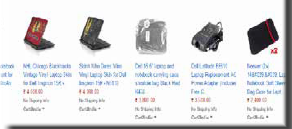
Following are some of the ads on Amazon. The following snapshot shows ads that are displayed to the user about what other users who performed the same search did on Amazon. This is related to the product in question.

The following snapshot shows ads of products related to the product that the user has searched. 

Since the products displayed are highly relevant to the user, the chances of conversion are much higher.

The following snapshot shows ads displayed from other ecommerce websites.


Some of the advantages that PLAs on ecommerce websites as compared to Google PLAs are:
• Chances of sales of associated products or competing products increases thereby increasing the chances of higher revenues
• Users can conveniently check reviews, ratings and feedback from other customers who bought the product. This can greatly help the user to make her final decision regarding the purchase of the product
• Product bundling is possible, therefore increasing the chances of higher revenues for the advertisers
• Product specifications are provided in greater detail

The user can perform other actions related to the purchase funnel, e.g., the user can save the product for later, or add it to her list of desired products. These actions increase the chance of future conversions.

Customer value

Google’s clients realise revenue once a conversion has been made. For example, customers can subscribe, buy their offerings etc. The costs realised are the bids placed for displaying the ads. The clients have to bid in realtime a user carries out a search on Google and Google Partner websites. The actual bid amount paid is that required to be just above the next player in the auction. So, the actual cost incurred with respect to the bid is lesser than what the bid was on the ad. There are various costing strategies employed, like cost-per-click and cost per 1000 impressions. All clients are provided with a free tool, Google Analytics. Clients can use this tool to assess the performance of their ads and compare with competitors. Clients even receive customised suggestions.

Challenges

• Reaching out to and convincing businesses to advertise on Google. Small businesses in particular, have huge future scope due to their large numbers.
• Educating clients about the usage of their services, like the various reports, to their advantage
• Poor infrastructure and limited penetration of the Internet, though it is increasing rapidly
• Increasing penetration of small screen devices, like smartphones and tablets. This limits the number of ads that can be displayed upon each search, thereby limiting revenues for both Google and its clients
• Increasing penetration of social media platforms and e-commerce websites
• Changing behavior of Google’s end users with respect to the searches performed. For example, users may look for an ecommerce site in specific, like Amazon, instead
of a product sold on it
• Google PLAs can lead to cannibalization of Google Ad-Words Text Ads as both ads are displayed side by side. Advertisers would focus solely on their own conversions and would dedicate a fixed amount of budget to their Google AdWords account, without dividing their focus onto PLAs and Text Ads. This may imply that Google would receive revenue from PLAs at the cost of Text Ads, which have, till date, been the primary and largest source of revenue for Google.

Opportunities for growth

• Regions across the world seeing rising Internet penetration and improving infrastructure to support Internet
• Customization of ads displayed to the users of Google’s platforms, for example, by using cookies, Google+ profiles etc.
• Expanding Google PLAs to more countries; it is currently available in 23 countries
• To limit cannibalization of Google AdWords Text Ads by Google PLAs, Google can change the costing strategy for the ads. Or, it may have a policy of limiting the Text Ads that can be displayed when PLAs are being displayed, or vice versa.
• Advertising on competitors’ websites. Though this may not help in expanding market share in the online advertising domain, it can lead to increased revenues for both Google and its advertisers, thereby ensuring that Google does not lose its existing share of advertisers.